
Thermistor B Value: Why Is It Essential For Accurate Temperature Sensing?
Discover the Thermistor B Value with DXM – a key parameter defining NTC thermistor performance. Learn how the B Value of Thermistor impacts temperature sensing accuracy and why it matters for your applications. Explore expert insights on Thermistor B Value now.
- Why the Thermistor B Value is Essential for Accurate Temperature Sensing
- Understanding the Thermistor B Value
- How the Thermistor B Value Affects Temperature Measurement Accuracy
- Calculating the Thermistor B Value: Methods and Accuracy
- 1. Basic Two-Point Method
- 2. Steinhart-Hart Equation
- How Thermistor B Value Determines Sensor Selection for Specific Applications
- Impact of Thermistor B Value Variations on Performance
- Conclusion
Why the Thermistor B Value is Essential for Accurate Temperature Sensing
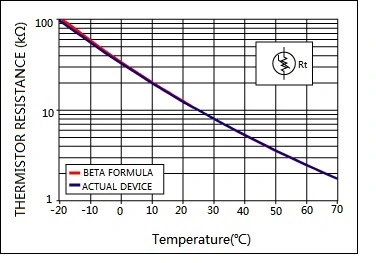
Thermistor B Value is a critical parameter for NTC thermistors, influencing their performance in various applications. Understanding the B Value Of Thermistor is key to achieving precise temperature measurements and selecting the right sensor for your application.In NTC thermistors, the NTC Thermistor B Value (β) defines the relationship between resistance and temperature. This parameter, often referred to as the NTC Thermistor Beta Value, is expressed in the following equation:
R(T) = R0 × e(β/T - β/T0)
where:
- R(T) is the resistance at temperature T (in Kelvin).
- R_0 is the resistance at a reference temperature T_0 (typically 25°C or 298.15 K).
- β is the thermistor's material constant.
Understanding and correctly calculating the Thermistor B Value ensures accurate temperature measurements, which is vital for applications where precision is critical.
These Negative Temperature Coefficient (NTC) thermistors, known for their high sensitivity and cost-effectiveness, are extensively used across industries.
Understanding the Thermistor B Value
The Thermistor B Value is a key material constant in NTC (Negative Temperature Coefficient) thermistors, defining their sensitivity to temperature changes. This NTC Thermistor Beta Value quantifies the relationship between temperature and resistance, where a higher value signals increased sensitivity, resulting in greater resistance changes for a given temperature shift.
A precise NTC Thermistor Beta Value is essential for accurate and linear temperature measurements. It impacts the thermistor's overall performance, influencing the sensor’s accuracy, linearity, and suitable temperature range.
The NTC Thermistor Beta Value not only determines the sensitivity but also affects the stability of the resistance-temperature curve. A stable B Value across a broad temperature range enhances linearity and measurement accuracy.
Selecting the right NTC thermistors for any application depends on understanding the B Value. This includes knowing how to calculate it using methods like the two-point approach or the more precise Steinhart-Hart equation.
Variations in the NTC Thermistor Beta Value can significantly impact performance, especially in high-precision applications. Compensation techniques or individual calibration may be necessary to maintain accuracy across different temperature ranges.
How the Thermistor B Value Affects Temperature Measurement Accuracy
The Thermistor B Value, or beta value, is crucial in determining temperature measurement accuracy. A higher NTC Thermistor Beta Value enhances sensitivity, allowing for more precise temperature readings.
- Sensitivity: A higher NTC Thermistor Beta Value increases sensitivity, resulting in more accurate temperature measurements.
- Linearity: The Thermistor B Value impacts the linearity of the resistance-temperature relationship. A stable NTC Thermistors B Value across the operating range improves linearity and accuracy.
- Temperature Range: Variations in the NTC Thermistor Beta Value can affect accuracy across different temperature ranges, potentially causing non-linearities in the readings.
The precision of mapping resistance to temperature relies heavily on the Thermistors B Value. Errors in the NTC Thermistor Beta Value can lead to significant inaccuracies, particularly in critical environments where precision is essential. Incorrect B Value may result in accurate readings at calibration points but diverge at other temperatures.
Understanding the NTC Thermistor Beta Value is vital for selecting the right NTC thermistor and ensuring accurate temperature monitoring across various applications.
Calculating the Thermistor B Value: Methods and Accuracy
The Thermistor B Value is a key parameter that influences the accuracy of temperature measurements. Understanding how to calculate the NTC Thermistor Beta Value is essential for ensuring precise sensor performance. Two primary methods are used for this purpose, each with varying levels of accuracy and complexity.
1. Basic Two-Point Method
This simple method calculates the NTC Thermistors B Value using resistance measurements at two different temperatures:
β = (T1 × T2) / (T2 - T1) × ln(R1 / R2)
Where:
- R1 and R2 are resistances at temperatures T1 and T2 (in Kelvin).
This method is straightforward but assumes a constant NTC Thermistor Beta Value across the temperature range, which may lead to inaccuracies.
2. Steinhart-Hart Equation
For higher accuracy, especially over a wide temperature range, the Steinhart-Hart equation is used:

Where:
- T is temperature in Kelvin.
- R is resistance in ohms.
- A, B, and C are Steinhart-Hart coefficients.
This method requires three data points to determine the coefficients, resulting in a more accurate calculation of the NTC Thermistors Beta Value and a better representation of the thermistor's behavior across different temperatures.
How Thermistor B Value Determines Sensor Selection for Specific Applications
The Thermistor B Value is a critical factor when selecting the right thermistors for specific applications. Understanding the NTC Thermistor Beta Value is essential to match the sensor's performance with the application's needs.
- Temperature Range: Different NTC Thermistor B Values are suited for specific temperature ranges. Choosing the correct Thermistors B Value ensures optimal performance within the desired operating range.
- Sensitivity Requirements: Applications needing high sensitivity should opt for thermistors with higher NTC Thermistor Beta Values.
- Linearity Needs: For applications where linear response is vital, select thermistors with stable B Values across the operating range.
- Interchangeability: When using multiple thermistors, selecting those with similar NTC Thermistor B Values ensures consistent system performance.
The right NTC Thermistors Beta Value is crucial, especially in applications that operate over wide temperature ranges. High-precision applications like medical devices may prefer thermistors with well-characterized B Values, often relying on the Steinhart-Hart equation to minimize errors. Less critical applications may find the two-point method sufficient.
Impact of Thermistor B Value Variations on Performance
The NTC Thermistor Beta Value is not uniform across all temperatures, which can have significant implications:
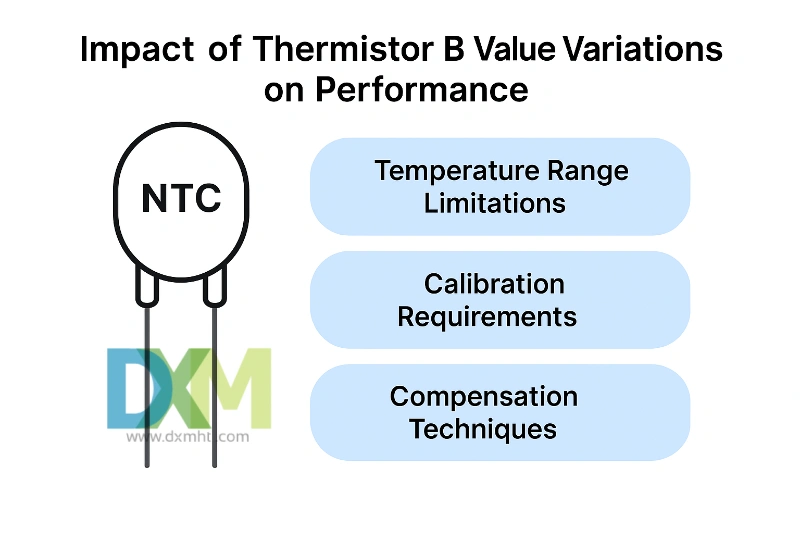
- Temperature Range Limitations: Variations in the B Value Of Thermistors can restrict the effective temperature range, affecting sensor performance.
- Calibration Requirements: High-accuracy applications may require individual calibration to address variations in the NTC Thermistors Beta Value.
- Compensation Techniques: Software or hardware compensation can be used to correct for Thermistors B Value variations and enhance overall accuracy.
Beta Value Variations and Their Impact:
- High-Temperature Applications: Small errors in NTC Thermistor B Value at high temperatures can cause large deviations in readings. Tightly controlled β values or the Steinhart-Hart equation are preferred.
- Low-Temperature Applications: At low temperatures, rapid resistance changes make the accuracy of the NTC Thermistor Beta Value crucial to avoid significant errors.
- Wide Temperature Range Applications: In applications with a broad temperature span, β variations can lead to cumulative errors. Accurate β characterization, often using the Steinhart-Hart method, is essential for consistent performance.
Conclusion
Understanding the Thermistor B Value is essential for effective use of NTC thermistors in temperature measurement. The NTC Thermistor Beta Value affects accuracy, sensitivity, and linearity, making it crucial for selecting the right thermistor for specific applications.
The NTC Thermistor Beta Value determines how well a thermistor performs in various conditions. While the basic two-point method offers a quick β estimate, more precise methods like the Steinhart-Hart equation are needed for accurate readings over a wide temperature range. Careful selection of the NTC Thermistors Beta Value ensures optimal performance and accuracy in temperature measurements.
Awareness of calculation methods and beta value variations helps achieve precise temperature readings and enhances overall system performance. For high-precision applications, understanding and choosing the correct Thermistor B Value is vital for achieving reliable and accurate temperature measurement.
© 2024 DXM Blog. All rights reserved.
Author: Ivan Huang - Updated on 4th August
Recommended for you

What Is Positive Temperature Coefficient? Expert Guide on PTC Thermistors

Unlocking the 103 Capacitor: An Essential Guide for Professionals

Where Can I Buy Resistors? Your Expert Sourcing Guide

How to Find Impedance of a Capacitor: Guide for Professionals

how to calibrate rtd pt100?

Capacitor 104 Value: Essential Guide for Electronics Professionals
Price and Payment
Do you offer bulk purchase discounts?
Yes, we offer bulk purchase discounts; the specific discount rate depends on the order quantity and cooperation method.
Payment Terms
There are a number of different payment methods that can be used when you deal with us. Two are mostly used: T/T payment in advance for small values and irrevocable L/C at sight for large values.
Are invoices provided?
Yes, we provide legal invoices that can be used for reimbursement and accounting records.
Logistics
Shipment
1)Small order quantity and small packing:cargo may be arranged by courier;
2)Bulk order and big volume:shipment may be arranged by sea or by air as per customer’s requirements on FOB, C&F,CIF or LCL terms and do prompt shipment which is very important for our customers, so we do this matter seriously and we may arrange our shipment in time due to our rich experiences in this line. We may also accept the shipment on the term of freight prepaid or freight collect.
Does it support express delivery?
Yes, we support express delivery services. You can choose different delivery methods according to your needs, including ordinary express delivery and expedited express delivery.
You may also like

PT1000 Temperature Sensor: DXM Precision Platinum RTD Solutions

KTY83-110 Sensor with Silicon Glass Thermistor

Bracket Type NTC Thermal Sensor MF52X for Precise Temperature Measurement

Glass Thermistors MF58E for High-Precision Applications

High Precise NTC Sensors for Temperature Measurement and Control

WMZ12A 75S PTC Thermistors for Over-Current and Over-Load Protection

SMD Sensors: Advanced Temperature Sensing Excellence

Thermistor PTC MZ11 Series for Light Efficient Design
Get in Touch
Discover premium thermistors, sensors, and resistors tailored to your needs.Our dedicated team of experts is available to assist with product selection, technical queries, and after-sales service. Contact us for custom solutions and experience exceptional customer support.


© 2025 DXM | All Rights Reserved.
 Scan QR Code
Scan QR Code
Whatsapp: +8618927361658
Shenzhen DXM Technology Co., Ltd.
DXM PTCNTC
Shenzhen DXM Technology Co., Ltd